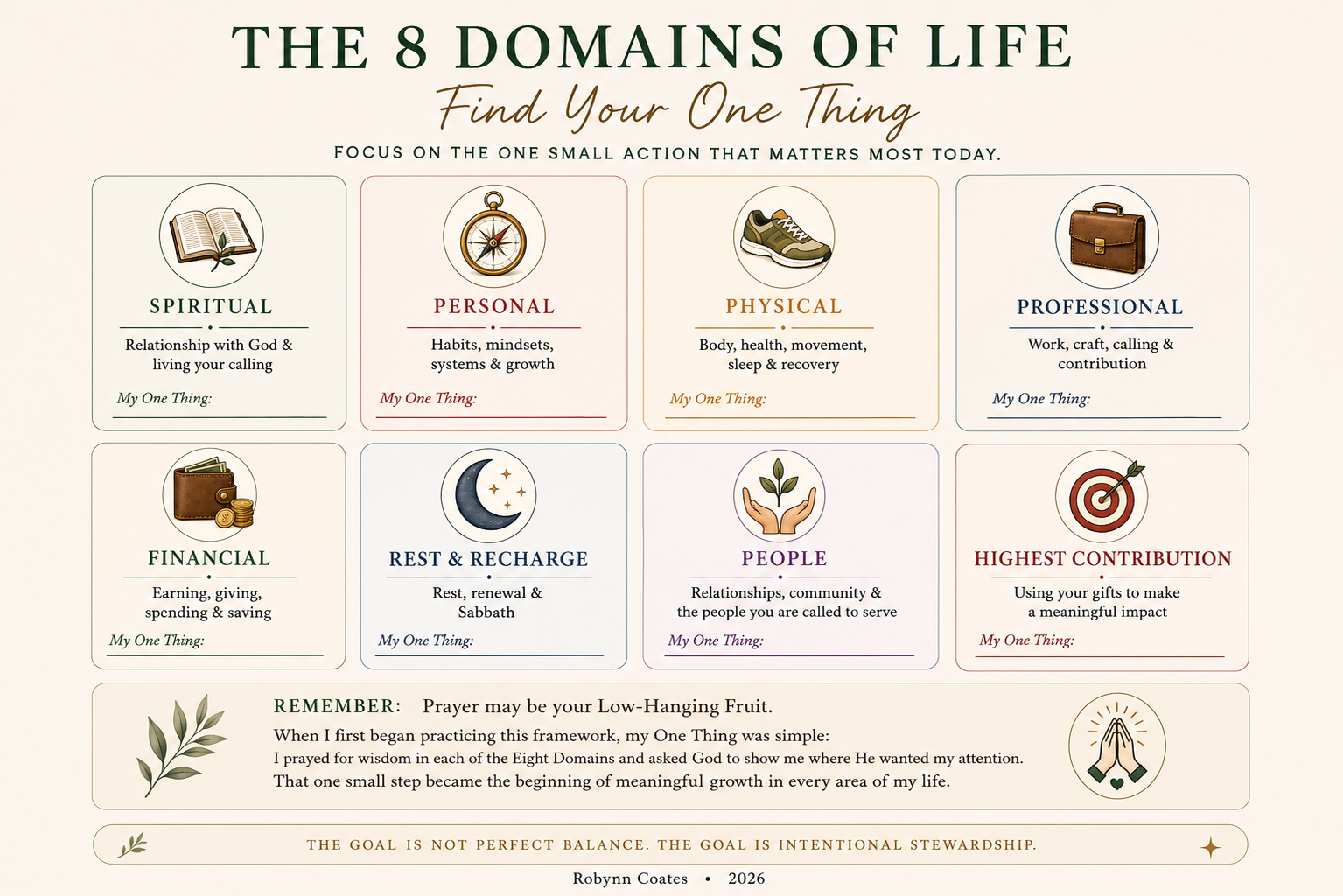
🌿 Low-Hanging Fruit in the Eight Domains

Have you ever known an area of your life needed attention—but felt unsure where to begin?

Sometimes we make the next step so big that we never take it.

That is where Low-Hanging Fruit comes in.

Low-Hanging Fruit is the smallest meaningful action that moves me in the right direction. 

🚫 Not the biggest action.
🚫 Not the most impressive action.
🚫 Not the action I would take if I had unlimited time, energy, money, and capacity.

✅ The faithful action that is actually available to me today.

When the idea for this framework first began taking shape, I wanted to practice it in my own life.

But I did not begin by choosing an action step for every domain. That would have felt like eight more things to do.

My Low-Hanging Fruit was simply this:

🙏 I prayed for wisdom in each of the Eight Domains and asked God to show me where He wanted my attention.

That was it.

I brought my spiritual life, personal growth, physical health, family, professional life, finances, rest, and relationships before Him.

I did not try to fix everything.
I did not create a plan for every area.
I simply prayed.

That small practice reflected the principle found in Proverbs 3:5–6:

“Trust in the Lord with all your heart
and lean not on your own understanding;
in all your ways submit to Him,
and He will make your paths straight.”

That was back in 2018.

It was a small action, but it was meaningful—and it became the beginning of a Low-Hanging Fruit habit I still practice today.

What began as one small seed has grown considerably across all Eight Domains. Over time, prayer led to greater clarity, specific action, stronger habits, and meaningful growth.

But it did not begin with a complete plan. It began with one faithful, doable step.

And that is what Low-Hanging Fruit looks like.

It doesn’t end there, but that’s where it starts. With a little seed you plant and then faithfully nourish.

Your Low-Hanging Fruit may look different. The key is that it is specific, meaningful, and doable—something you can complete.

Here are some more examples:

🙏 Spiritual
Read one verse and ask God to speak to your heart through it.

🌱 Personal
Make your bed upon waking.

🏋🏻‍♀️ Physical
Do twenty squats when you first wake up—or after you make your bed. 😉

🏡 Family
Tell your family members you love them when you say good night.

💼 Professional
Write down the most important task you need to complete today.

💰 Financial
Open your banking app and check your balance.

🔋 Rest & Recharge
Set a bedtime reminder on your phone.

🤝 People & Highest Contribution
Write down the name of one person you want to pray for today.

None of these actions may look impressive.

But they are doable—and doable matters when we are trying to get started, build consistency, and create momentum.

Low-Hanging Fruit is valuable in every season, but it becomes especially important when capacity is low.

We do not abandon stewardship; we simply adjust the size of the faithful step.

So instead of asking:

❓ “How do I fix my whole life?”

We can ask:

🌿 What is one small, meaningful action I can complete today?

The acorn does not need to become the oak tree today.

It simply needs to be stewarded faithfully.

The Three Scorecards

In my last post, I shared the Eight Domains of Life—a framework I use to see the whole field of my life and steward it more intentionally.

But once we identify the different areas we have been entrusted to steward, another question surfaces:

How do we accurately evaluate how we are doing?

Recently, I got together with a friend, and we spent some time looking back over our growth from the past year.

We were trying to rate ourselves in different areas, and both of us kept running into the same problem:

It was hard to know how to score ourselves.

At first, I thought maybe we were just overthinking it.

But later it dawned on me:

We were trying to answer three different questions with one score.

There is a big difference between asking:

🌱 Was I faithful with what God asked me to do?

🌳 What maturity has developed over time?

🔋 What capacity do I actually have in this season?

Those are not the same questions.

They are three different scorecards.


🌱 Faithfulness Scorecard

Am I planting the seeds God is asking me to plant today?

🌳 Maturity Scorecard

What fruit has grown over time?

🔋 Capacity Scorecard

What resources do I currently have available?


This became especially clear when we got to the area of relationships and community.

My friend used to be a social butterfly. She loved being around people. But lately, she has wanted to stay home more.

And she wasn’t sure how to rate herself.

Was that bad?
Was she less loving?
Was something wrong?

But as we talked, I realized we may not have been looking at a character issue.

We may have been looking at a capacity issue.

Sometimes we condemn ourselves because we are using a capacity score as a character score.


🗓️ “I don’t want to attend three social events this week.”

💭 So we think,
“Maybe I don’t love people well.”

👉 But maybe we’re tired.


📋 “I don’t have the energy to start a major project right now.”

💭 So we think,
“Maybe I’m lazy.”

👉 But maybe we’re depleted.


🧠 “I can’t focus for hours like I used to.”

💭 So we think,
“Maybe I’ve become undisciplined.”

👉 But maybe we’re carrying stress, grief, health changes, hormonal changes, or overload.


A low capacity score does not automatically mean there is a character problem.

That distinction matters because the solutions are different.

🌱 If it’s a faithfulness issue, the next step may be to repent, obey, or act.

🌳 If it’s a maturity issue, the next step may be to practice, learn, grow, and stay the course.

🔋 If it’s a capacity issue, the next step may be to rest, recover, replenish, or adjust.

Of course, capacity should not become an excuse to avoid what God is asking us to do.

But neither should the language of faithfulness be used to condemn ourselves for having genuine human limitations.


The acorn and the oak tree should not receive the same maturity score.

But both can receive a high faithfulness score.

The win is not becoming the oak tree today.

The win is planting and stewarding today’s seed.

And God gives the growth. 🌿🌳


The Three Scorecards ToolSheet is a simple printable guide to help you walk through this question in your own life:

The guiding question is:

Is this a faithfulness issue, a maturity issue, or a capacity issue?

Because sometimes we are trying to solve the wrong problem.

We may be treating a capacity issue like a character flaw.

Or treating a maturity issue like a schedule problem.

Or treating a faithfulness issue like we just need more rest.

That is why this matters.

The Eight Domains help us see the whole field.

The Three Scorecards help us understand what we are seeing.

And once we diagnose the right problem, we are much more likely to apply the right solution—and identify the faithful next step.

The 8 Domains of Life

Have you ever wanted to be more intentional with your life but felt overwhelmed because you didn’t know where to begin?

🙋🏻‍♀️ I have.

I am both a box-checker and a squirrel-chaser — which can be an interesting combination.

I can make a list, put my head down, and diligently check the boxes.

But I can also spot a new idea, opportunity, or problem that needs solving and take off after it.

Before I know it, I may be getting a lot done — but I have gotten out of bounds.

One area of my life is receiving nearly all my attention while other things that matter have quietly slipped out of view.

For years, I worked hard to close the gap between where I was and where I wanted to be, but I never seemed able to close it.

It wasn’t because I didn’t care.

It wasn’t because I wasn’t trying.

I didn’t have a clear system for intentional growth and stewardship.

Everything that mattered was swirling around together in one big mental pile:

My relationship with God.
My habits and personal growth.
My physical health.
My family.
My work.
Our finances.
Rest.
The people God had called me to love and serve.

All of it mattered.

And that was part of the problem.

When everything feels important at once, it can be hard to recognize what needs attention — and what may be quietly neglected.

In Haggai 1:5, God’s people were told:

“Give careful thought to your ways.”

That verse had a specific context, but the principle still challenges me:

God’s people are called to pay attention to how we are living, what we are prioritizing, and whether we are faithfully stewarding what He has entrusted to us.

And Ephesians 2:10 reminds us why this matters:

“For we are God’s handiwork, created in Christ Jesus to do good works, which God prepared in advance for us to do.”

I love that verse.

But I also think phrases like “good works” can become so familiar that they almost turn into white noise.

We know they matter.

But we may not always know how to translate them into real life.

What do good works look like on a Wednesday morning?

What does faithfulness look like in this season, in this body, with this family, with these responsibilities, with this capacity, and with this assignment?

The good works God has prepared for us to walk in were never intended to be vague, floating assignments somewhere “out there.”

They show up in the actual life we have been given.

That is one reason I began dividing life into eight domains — not because life fits into neat little boxes, but because these categories help me see where faithfulness and good works may need to be stewarded in real life:

🙏 Spiritual
My relationship with God, understanding of my calling, and faithfulness in living it out.

🌱 Personal
How I steward myself — my habits, mindsets, emotional health, responsibilities, systems, and growth.

🏋🏻‍♀️ Physical
How I steward my body through my thoughts, eating, movement, sleep, health, and recovery.

🏡 Family
My care, presence, and investment in my immediate family.

💼 Professional
The work, craft, calling, service, or contribution God has entrusted to me — paid or unpaid.

💰 Financial
How I earn, give, spend, save, and steward financial resources.

🪫 Rest & Recharge
The rhythms of rest, renewal, and Sabbath that replenish me for my Sacred Mission.

🤝 People & Highest Contribution
My relationships with extended family, friends, community, and the people God has entrusted me to love, help, and serve.

This is simply how I have chosen to organize the domains of life.

Other people may divide them differently.

The exact categories are not the most important part.

The important thing is having a framework that helps us step back, examine our whole life, and live intentionally.

Because what we do not intentionally examine is easy to unintentionally neglect.

This is not about perfectly balancing all eight areas or giving each one equal time and energy.

Different seasons require different priorities.

And this is not about turning life into one enormous checklist or trying to earn God’s approval through performance.

Our worth is settled in Christ.

This is about intentional stewardship.

The Eight Domains help me ask:

➡️ Where am I currently investing my attention?
➡️ Has one domain taken me out of bounds?
➡️ Is something important being quietly neglected?
➡️ What is God asking me to prioritize in this season?
➡️ Where are the good works right in front of me?
➡️ Where is love asking for action?
➡️ Where am I being invited to bear good fruit?

The goal is not to manage every area perfectly.

The goal is to see all of life clearly enough to faithfully steward what God has placed in front of us.

Because good works are not just big, impressive, public things.

They may look like:

➡️ Prayer
➡️ Repentance
➡️ Taking care of your body
➡️ Loving your family well
➡️ Doing excellent work
➡️ Managing money wisely
➡️ Resting instead of striving
➡️ Seeing the person right in front of you and choosing love

The Eight Domains take the mystery out of faithfulness by helping me see where stewardship is needed and what low-hanging fruit action I can take today.

The Eight Domains take the mystery out of faithfulness by helping me see where stewardship is needed and what low-hanging fruit action I can take today.

So if you want to be faithful, but you’re not sure where to begin, start by looking at the life God has actually entrusted to you.

Where does stewardship feel unclear?

Where does something need attention?

Where might one small, faithful step begin to move things in the right direction?

That is where the Eight Domains become helpful.

They give us a way to see our whole life — and begin cultivating what God has placed right in front of us. of us.

All-American {Easy} Apple Pie

It’s been fun watching videos of Europeans discovering America during the World Cup.

They’ll come here expecting one thing and end up surprised by something completely different—the wide-open spaces, oversized everything, free refills, Buc-ee’s, ranch dressing, friendly strangers, and yes… our food. 😊

This whole Americana theme, along with the 4th of July just around the corner, got me thinking about some of those simple things that feel uniquely American.

Things like backyard cookouts, baseball games, 4th of July parades, fireworks… and apple pie. 🇺🇸⚾🎆🥧

That reminded me of a little recipe from my teaching days that feels worth passing along. 

One day, while a group of fellow teachers and I were having lunch, one of my friends said, “I’ve got the easiest apple pie recipe.”

Naturally, I grabbed a pen and paper.

She said, “Put that away. You don’t need it.”

Then she gave us the recipe, and it went something like this:

Start with a pie crust. Layer it with apples, sugar, cinnamon, flour for thickening, and pats of butter. Then do it again. And again. Keep stacking it as high as you can while still getting the top crust to fit.

She emphasized stacking it as high as you can because the apples cook down as they bake.

Then she added the part I remember most:

“If you think you’ve added too much butter… add more.”

😂

No exact amounts. Just the ingredients and the clear impression that the measurements were more like personal preferences than rules.

So I went home determined to make this pie.

I’d never made an apple pie before.

I followed her instructions—even though I didn’t have a single precise measurement. 😄

I piled those apples so high it looked ridiculous. It wasn’t a pie anymore—it was a mountain with a crust on top.

And that was the point.

︵‿︵‿︵‿︵

Little recipe note: One thing that’s hard to capture in a written recipe is just how high to stack the apples. If you’re curious, I included an old video below where you can actually see how ridiculously high I pile them. 🍎 It also includes a few little details I didn’t mention here, like brushing the crust with milk before sprinkling sugar on top.

︵‿︵‿︵‿︵

Then came the tricky part: somehow I got the top crust stretched over the whole thing, cut a few slits in the top, sprinkled it with sugar, and put it in the oven.

About halfway through baking, I realized I’d forgotten to put a pan underneath it.

Butter was bubbling out the sides and dripping all over the bottom of my oven.

But the pie?

Absolutely amazing.

The next day, I told my students the story.

They loved it.

Of course, I’m guessing it wasn’t the story they loved as much as the time it took away from science to tell it. 🤭

And that pie became my apple pie recipe from that day forward.

So in honor of the upcoming 4th of July, I thought I’d share it.

Because sometimes the sweetest traditions start simply:

one friend sharing a recipe,
one homemade pie,
and a table full of people to share it with.

🇺🇸✨

If you’re a free spirit in the kitchen, feel free to improvise.

But if you like a little more guidance, here’s the closest thing I have to an actual recipe:

All-American Apple Pie

• 2 pie crusts
• 10–12 apples, peeled and sliced
• 1 heaping cup sugar
• Cinnamon
• 6 tablespoons flour for thickening
• 1 stick butter, cut into pats

Layer everything in the crust.

Then layer it again.

And again.

Pile it as high as you can.

Top with the second crust, cut a few slits, brush with milk, sprinkle with sugar, and bake at 375° for about 70 minutes.

And don’t forget to put a pan underneath it.

Trust me on that one. 😉

I’m sharing this a little early in case you want to plan ahead for the 4th.

🇺🇸✨ Wishing you a sweet and wonderful 4th of July. 

You can watch the video here to get an idea of just how high to pile the apples.  👇

The 3-Tier Focus Finder™


{Why Order Matters}

Were you one of those kids in math class who asked:

🙋‍♀️ “When are we ever going to use this in real life?”

LOL, I’m pretty sure I was. 😄

Math was never my strongest subject, but two things still stand out all these years later: 

➡️ FOIL
➡️ Order of Operations

And here’s the funny thing…

The older I get, the more I realize my math teachers were teaching something far bigger than math.

Because God seems to have woven this principle into His creation:

🧭 First things have to come first. There is an order to things.

Not because some things don’t matter.
But because some things come before other things.

In math, the order is already given to you.

In life?

Not so much. 😅

Life hands you a pile of challenges and says:

“Now figure out what comes first.”

And that’s where many of us get stuck.

Not because we’re lazy.
Not because we’re unwilling.

But because sometimes we are trying to solve the problem at the wrong level.

For years, in my pursuit of Peace with Food, I focused mostly on the visible things:

➡️ What I was eating
➡️ How much I was exercising
➡️ My calories
➡️ My workouts

Those things matter.

A lot.

But after menopause, I discovered something:

I couldn’t always solve a Tier 1 problem with a Tier 2 or Tier 3 solution.

Sometimes the issue wasn’t that I needed:

➡️ more discipline
➡️ a better meal plan
➡️ a harder workout
➡️ a new strategy

Sometimes the real issue was upstream.

It was things like:

➡️ hormones
➡️ recovery
➡️ chronic stress load
➡️ emotional health
➡️ thought patterns
➡️ underlying physical factors

Those things were affecting everything downstream.

That’s what led me to create what I now call:

The 3-Tier Focus Finder™

🌿 Tier 1: Foundations
Spiritual, mental, emotional, and underlying physical factors.

This tier asks:

“What’s driving this?”

🌿 Tier 2: Daily Habits
Sleep, eating, exercise, hydration, and stress management.

This tier asks:

“What daily habits support health and growth?”

🌿 Tier 3: Optimization
Supplements, specialized protocols, advanced strategies, timing tweaks, and fine-tuning.

This tier asks:

“How can I optimize what is already working?”

Before I understood this principle, I usually went straight to Tier 2 or Tier 3.

The eating strategy.

The exercise plan.

The supplements.

The fine-tuning.

The newest “this might be the thing” solution.

The “tell me what to do” plan. 

That was the approach I knew.

And if I’m being real… 😄
those things can feel more fun and more actionable.

But this lens helped me slow down and ask:

“What’s actually driving this?”

Because often, the thing I’m trying to fix is not the real source.

🌿 Sometimes the eating struggle isn’t only about eating.

🌿 Sometimes the productivity struggle isn’t only about time management.

🌿 Sometimes the relationship struggle isn’t only about communication.

🌿 Sometimes the health struggle isn’t only about effort.

🌿 Sometimes the symptom is simply where the pressure-release valve shows up.

That’s why I’ve become so passionate about this question:

Am I working on the symptom, or am I working on the source?

Before asking:

➡️  “What should I do?”

I’m learning to ask:

➡️  “What comes first?”

Because sometimes the breakthrough isn’t found in working harder.

Sometimes it’s found in working on the right thing first.

🌿 Work on the source, not just the symptom by going upstream.

Build the foundation.

Steward the daily habits.

Then optimize. 

Get Your Posse

As I close out this series on stages and seasons, one thing has become especially clear to me:

Some parts of life are windows. They open for a time, and then they close. We only get one childhood, one particular age, one season of raising little ones, one version of a chapter. And when they are gone, they are gone. Forever.

Other parts of life return again and again.

Throughout our lives, we experience new beginnings, long stretches of steady faithfulness, times of fruitfulness, seasons of loss, and winters when much of what God is doing remains hidden. The circumstances change, but many of the patterns repeat.

The thread running through this entire series has been the importance of being aware of these seasons and patterns so you can be appropriate in the moment.

Appropriate in the moment is the phrase I use for recognizing what this particular stage or season requires—and responding accordingly.

John C. Maxwell calls this the Law of Timing. He says:

⏳ The wrong action at the wrong time leads to disaster.
⏳ The right action at the wrong time brings resistance.
⏳ The wrong action at the right time is a mistake.
⏳ The right action at the right time results in success.

As John puts it, when to act is as important as what to do and where to go.

It is not enough to know what is good. We need wisdom to recognize what is appropriate now.

But as I finish this series, there is one more lesson I do not want to leave out. And if you’ve followed my posts for any amount of time, it probably won’t come as a surprise:

🤠 Get your posse.

We need people beside us through every season—people who cheer us on, celebrate the harvest, offer a shoulder when we are hurting, and remain close when the road becomes difficult—and people we can encourage, strengthen, and help in return.

And sometimes, what we especially need is someone who has already traveled farther down that road.

After I went through what I call my perfect storm, I had a conversation with my former pastor, Rick. He is in that oak-tree, mature stage of life—deeply rooted, steady, and a very humble mentor.

As I told him where I had been and what I was experiencing, he began walking me through the stages of Christian maturity.

My jaw dropped.

It was as though he were reading my mail. He described my life almost to a T.

That was when something clicked for me:

This was a pattern.

While our journeys are deeply personal, they are not entirely unique. We may have different stories, personalities, and circumstances, but we often travel through similar stages, face similar questions, and experience similar patterns of grief, disappointment, confusion, growth, and renewal.

Yet when we are in the middle of something difficult, it can feel as though no one else could possibly understand. Isolation tells us that something must be uniquely wrong with us—that we are the only ones struggling, questioning, grieving, or trying to find our footing.

Then we sit down with someone who has walked a similar road and the light switch comes on.

Pastor Rick helped me see:

You are not alone. This is part of the journey. Keep going.

I remember wishing I had spoken with him sooner.

His wisdom would not have removed the difficulty, but it could have removed so much of the confusion. He could have helped me recognize the terrain, avoid a few landmines, and understand that some of what I was experiencing was normal—not evidence that I had completely lost my way.

That is one of the greatest gifts a mentor can give us.

They cannot walk the road for us, but they can help us understand where we are. They can remind us of what is true when we cannot yet see clearly. And they can help us respond in a way that is appropriate for the moment.

But eventually, this comes full circle.

At some point, we are invited to turn around and offer that same gift to someone coming behind us.

Scripture says that God comforts us in our troubles so that we can comfort others with the comfort we ourselves have received from Him. (2 Corinthians 1:3–4)

Nothing surrendered to God is wasted—not even the difficult seasons.

🧭 Your experience may become someone else’s reassurance.
🌱 Your healing may become someone else’s hope.
🕯️ Your hard-earned wisdom may help someone else navigate the road with less fear and confusion.

So as you move through the stages and seasons of life:

Find someone ahead of you.
Walk with people beside you.
And turn around for someone behind you.

🤠Get your posse—and become part of someone else’s. 🌿

For those who want to go deeper… 🌳🧭

I created a full-length guide called Match the Guide to the Terrain. This is not a quick read—it is closer to a short book—but it explores this idea in much greater depth.

Inside, we unpack:

  • the difference between knowledge and seasoned wisdom
  • why some seasons require someone who has actually walked the road
  • what may be happening when the old spiritual equations stop working
  • how God moves us from confidence in outcomes to deeper trust in Him
  • who to go to for what—therapists, pastors, theologians, seasoned believers, physicians, friends, and other specialists
  • what to look for in a trustworthy guide
  • common mistakes we make when seeking counsel
  • reflection questions and an extensive Scripture study list

For anyone navigating a long, confusing, age-specific, or spiritually complex season—or helping someone who is—this guide is designed to help you recognize the terrain and find the right kind of wisdom for the road.

Read Match the Guide to the Terrain here:

https://docs.google.com/document/d/1koYx8vZgdQH9OqdZBwXJQe9NGV764WxKfZHJuxgjgv8/edit?tab=t.0#heading=h.e2xarvcq9z07

Living In Season: The Art of Living

There’s a tension I think many of us feel.

We want to be present where we are…
but we also want to have hope and expectation for what’s ahead.

So which is it?

👉 Do we enjoy the moment?
👉 Or do we prepare for what’s next?

I think the answer is both.

Because life is seasonal.

“To everything there is a season, and a time for every purpose under heaven.” —Ecclesiastes 3:1 (NKJV)

Every season has a purpose.


And wisdom is learning how to live appropriately in the moment we’re actually in.

Not the moment we wish we were in.
Not the moment we’re afraid is coming.
Not the moment we keep replaying from the past.

This one.
Right here.

“…a wise heart will know the proper time and the right procedure.” —Ecclesiastes 8:5 (AMPC)

That verse points out that wisdom isn’t just knowing what to do.

It’s knowing when to do it.

👉 When to plant.
👉 When to wait.
👉 When to build.
👉 When to rest.
👉 When to celebrate.
👉 When to release.
👉 When to trust.

And that, to me, is part of the true art of living:

👉 Be appropriate in the moment.

Because when we confuse the seasons, we can start working against grace.

We rush what needs time.
We cling to what needs released.
We resist what God is using.
We panic in winter.
We quit in summer.
We forget to celebrate in fall.
We try to harvest in spring before roots have had time to grow.

And just being transparent… I have done all of the above. 🙋‍♀️

But here’s the simple reset I keep coming back to:

👉 Be where you are while becoming who you’re called to be.

Being present does not mean you have no vision.
And having expectation for the future does not mean you despise where you are.

You can enjoy today…
and still believe God is doing more.

But especially when life is hard, staying present takes practice. And I have found that one of the best ways to practice being present is gratitude. 💛

Gratitude anchors me. It steadies my perspective.

It helps me notice the goodness of God in this moment instead of rushing past the life right in front of me with all its richness and blessings.

Because this season won’t last forever.

That means:

👉 You don’t have to cling to it.
👉 You don’t have to rush it.
👉 You don’t have to resist it.

You can walk with God in it.

🌸 Spring — Start Well
➡️ Plant intentionally
➡️ Don’t rush
➡️ Focus on what matters most

☀️ Summer — Stay Faithful
➡️ Keep showing up
➡️ Be faithful in the process
➡️ Endure

🍂 Fall — Respond Wisely
➡️ Celebrate what’s good
➡️ Learn from what’s not
➡️ Adjust without shame

❄️ Winter — Trust Deeply
➡️ Don’t panic
➡️ Lean into God
➡️ Receive the deeper work

The goal isn’t just to hurry into the next season.
The goal is to walk with God in this one.

So instead of rushing ahead…
or resisting where you are…

🌿 Enjoy where you are while becoming who you’re called to be.

Winter Is Not Wasted

Pain, Questions & Hidden Formation

I’ll be transparent—winter has never been my favorite.

Growing up in South Dakota, winter could feel like it went on…
and on…
and on.

The cold.
The gray.
The waiting.

And sometimes life feels that way too. 

Not the cozy winter with the fire, blanket, and warm drink.

I’m talking about the winter seasons of life.

The kind where everything seems to hit at once.
The kind where you’re tired before the day begins.
The kind where you keep asking:

👉 God, where are You?
👉 What are You doing?
👉 Why is this taking so long?
👉 Is anything growing here?

And maybe the hardest one:

👉 Why does it feel like You are silent?

︵‿︵‿︵‿︵

Winter can feel disorienting.

It can feel like nothing is happening.
It can feel like the prayers are hitting the ceiling.
It can feel like the old ways you heard God, sensed God, or understood life suddenly don’t feel the same.

And that can be painful. But Scripture never tells us trouble won’t come. Jesus said:

“In this world you will have trouble. But take heart! I have overcome the world.” —John 16:33 (NIV)

So when winter comes, we don’t have to assume God has left us.

Winter is not proof we are forgotten.
Winter is part of life in a fallen world.

But it is also a place where God can do deep redemptive work.

︵‿︵‿︵‿︵

C.S. Lewis wrote that God whispers to us in our pleasures, but shouts in our pains.

And I think that is often true.

Pain gets our attention.
It slows us down.
It exposes what was hidden.
It shows us where we were leaning on control, clarity, comfort, or outcomes.

But I also want to say this carefully:

Sometimes winter does not feel like God is shouting.
Sometimes winter feels like God is silent.

And that does not mean He is absent.

It may mean the work is happening deeper than our emotions can measure.

︵‿︵‿︵‿︵

James tells us that trials test our faith and produce perseverance.

Romans tells us that suffering can produce perseverance, character, and hope.

Not because pain is good.
Not because suffering is easy.
Not because we pretend hard things don’t hurt.

But because God is able to form something in us through what we would never have chosen.

Winter can produce things summer never could.

Humility.
Depth.
Compassion.
Perspective.
Endurance.
Dependence on God.

︵‿︵‿︵‿︵

And this is why our mindset about winter matters.

If we believe winter is wasted, we may panic.
If we believe winter means God is absent, we may despair.
If we believe winter is only something to escape, we may miss what God is forming.

But if we understand that winter is part of life…

and that God can work even when we cannot see it…

then we can become less panicked and more faithful.

We can ask:

👉 What does this season require?
👉 What needs to be protected?
👉 What needs to be released?
👉 What is the next faithful step?

That’s wisdom.

That’s AIM:

Appropriate in the Moment.

Not forcing spring in the middle of winter.
Not pretending winter doesn’t hurt.

But learning to respond faithfully in the season we are actually in.

︵‿︵‿︵‿︵

Romans 8:28 says:

“And we know that in all things God works for the good of those who love him.” —Romans 8:28 (NIV)

That does not mean all things are good.

They are not.

Some things are painful.
Some things are confusing.
Some things are unjust.
Some things are heartbreaking.

But God is able to work in all things.

He can redeem what we would never have chosen.

He can bring humility from pain.
Compassion from suffering.
Wisdom from confusion.
Depth from loss.
Ministry from wounds He has healed.

︵‿︵‿︵‿︵

After we have walked through winter, we often carry something we could not have carried before.

We become more tender with people.
More patient with process.
More compassionate toward those who are disoriented.
More aware that life is not always simple.

And maybe, after winter, we become the kind of person who can sit with someone else in their pain without rushing them, fixing them, or throwing clichés at them.

We can simply say:

“I know this is hard.
I know this feels dark.
But you are not alone.
And winter is not wasted.”

︵‿︵‿︵‿︵

❄️ Final Thought

Life is not linear.

It is seasonal.

And wisdom is learning:

➡️ what season you’re in
➡️ what that season requires
➡️ how to respond faithfully
➡️ where God is inviting trust

Winter can be painful.
Winter can feel long.
Winter can feel quiet.

But winter is not the end.

Spring does come.
And even before it does…
God is still God.

He is still present.
He is still faithful.


And He is still able to redeem what winter has buried.

Fall

If I had to use one word to describe the feeling of fall, it would be this: 👉nostalgic.

There’s just something about it…

A longing for something familiar. That sentimental feeling you can’t quite explain—like a quiet kind of homesickness…
👉 but in the best kind of way.

Some of my favorite fall memories take me way back… 

🏫 The smell of the school building after summer.
The excitement of seeing friends again.
The whole-school energy of reconnecting — classmates, teachers, staff, coaches, and administrators who felt like part of the family in our small school.

🏀 And in South Dakota, back then, girls played basketball in the fall — so that season carried a lot of life for me personally: teammates, coaches, practices, games, bus trips, and that familiar energy of being together again.

🏈 And then, of course, football.
Friday night games, cars lined up around the field, the anticipation before kickoff, and horns honking every time someone scored.

Go Wheelers! 🛞

🍂 That’s what fall feels like to me:

a return to something familiar.
Simple.
Meaningful.
A little nostalgic in the best kind of way.

But fall doesn’t just make us feel something.

It also shows us something.

Because if I had to use one word to describe what fall does, it would be this:

👉 reveals.

︵‿︵‿︵‿︵

Fields that were worked all summer…
now show their harvest.

And everywhere you look…
👉 there is evidence of what has been growing.

︵‿︵‿︵‿︵

Fall has a way of bringing things into view.

It’s not just a season you experience…
👉 it’s a season that reveals.

︵‿︵‿︵‿︵

🌾 What Fall Represents

In the seasons of life, fall is the season of: 

➡️ Harvest
➡️ Results
➡️ Outcomes
➡️ The “Reveal”
➡️ Momentum—compounded, for good or for bad

It’s when what was planted in spring
and tended in summer…

👉 becomes visible.
👉 and is brought into the light.

This is where we begin to see what has been formed—

both in us and around us. 

︵‿︵‿︵‿︵

✅ When the Harvest Is Good

There are seasons where you step back and see:

✔ Fruit from what was planted
✔ Growth that actually happened
✔ Effort that produced something meaningful

And there is something deeply satisfying about that.

👉 Seeing what your faithfulness produced
👉 and recognizing what God produced through it.

︵‿︵‿︵‿︵

🎉 Appropriate Action: CELEBRATE

Not quickly moving past it.
Not minimizing it.

But truly:

👉 celebrate it.

➡️ Thank God for it
➡️ Acknowledge what worked
➡️ Receive the fruit with gratitude

“Every good and perfect gift is from above…” —James 1:17 (NIV)

Because sometimes we rush past what God has grown through our faithful obedience…

👉 without ever pausing to recognize it. 

︵‿︵‿︵‿︵

⚠️ When the Harvest Is Not What You Hoped

But fall also brings a kind of honesty we don’t always expect.

Because not every harvest is what we hoped for.

➡️ Some things didn’t grow like we thought
➡️ Some seeds didn’t produce what we expected
➡️ Some areas were neglected
➡️ And some seeds produced a harvest we didn’t want

And fall doesn’t hide that.

👉 It brings it into the light
👉 often so God can redirect, refine, or restore.

︵‿︵‿︵‿︵

And if we’re transparent…

that can be hard.

Because fall answers the question summer was asking:

👉 “Was this working?”

︵‿︵‿︵‿︵

🌿 The Gift Hidden in Fall

But here’s what I’ve come to see:

👉 Fall isn’t about judgment… it’s about clarity.

It shows you:

➡️ What worked
➡️ What didn’t
➡️ What needs your attention

And that kind of clarity…

👉 is actually a gift.

👉 and often an invitation from God to adjust what comes next.

︵‿︵‿︵‿︵

Scripture reminds us:

“A man reaps what he sows.” —Galatians 6:7 (NIV)

Not as a threat…

👉 but as a principle we can learn from—and use for our good and the good of others.

︵‿︵‿︵‿︵

🌿 Appropriate Action: CONTEMPLATE

Not with shame.
Not with regret.

But with honesty and curiosity.

👉 contemplate it.

➡️ What seeds were planted?
➡️ What patterns were at play?
➡️ What might need to change next time?
➡️ Where is God inviting me to adjust?

“Let us examine our ways and test them…” —Lamentations 3:40 (NIV)

Because fall isn’t the end of the story…

👉 it’s insight for what comes next.
👉 and an opportunity to realign with God.

︵‿︵‿︵‿︵

🌿 A Path Forward (Redemption & Grace)

And this is important…

Because when we start talking about seeds and harvests, it’s easy to feel things like:

👉 regret

👉 shame

👉 disappointment

👉 discouragement 

︵‿︵‿︵‿︵

But here’s the truth:

👉 Even when the harvest is painful…

God is still the God of redemption. 

︵‿︵‿︵‿︵

If you recognize that you’ve planted seeds you wish you hadn’t…

👉 the story is not over. 

You can:

➡️ Confess
➡️ Turn toward God — this is what “repent” means 
➡️ Begin planting something different

“If we confess our sins, he is faithful and just and will forgive us…” —1 John 1:9 (NIV)

︵‿︵‿︵‿︵

And for the harvest you’re currently walking through…

👉 there is grace for that too.

Some things:

➡️ God will walk you through
➡️ God will strengthen you in
➡️ God will use to form something deeper in you

And some things…

👉 God will help you uproot, change, and move beyond over time.

︵‿︵‿︵‿︵

“And we know that in all things God works for the good of those who love him…” —Romans 8:28 (NIV)

︵‿︵‿︵‿︵

So whether your harvest is something to celebrate…

or something you wish looked different…

👉 you are not without hope.

︵‿︵‿︵‿︵

Because with God:

👉 nothing is wasted
👉 nothing is beyond His redeeming power
︵‿︵‿︵‿︵

Question:

👉 What is this season revealing — and where might God be inviting redemption, realignment, or new growth? 

Summer

Growth, Work & Endurance

Principle to Tap Into ⇨ STAY FAITHFUL & ENJOY

When we think about planting in spring and harvesting in fall…

it’s easy to forget something important:

👉 Life is lived in between.

If all we did was plant and wait for harvest… we would miss so much of what actually makes life rich.

︵‿︵‿︵‿︵

And for me?

Summer has always been my favorite. ☀️

There’s something about summer that seems to bring out the kid in us. Even growing up on the farm—yes, the days were long…

yes, there was work to be done…

yes, summer meant sweat, effort, and responsibility…

But when I think about summer?

👉 It’s where so many of the good things happened.

And I wonder…

What comes to mind for you?

Because while the details may look different for each of us, most of us carry summer memories somewhere inside us. For me, it was:

👉 hanging out with friends at Lake Mirage
👉 meeting up at the West Side Cafe
👉 early morning runs with my dog down gravel roads
👉 waiting for the mail and hoping there might be a letter from a friend 📬

And maybe for you it was:

👉 riding bikes until dark
👉 ballgames
👉 swimming pools
👉 fireworks
👉 catching lightning bugs
👉 family vacations
👉 staying outside until the streetlights came on

But whatever it was…

☀️ there’s a feeling to summer.

A fullness.

A lightness.
A sense that life is moving—
and you’re right in the middle of it.

Full of life.
Full of energy.
Full of moments you don’t want to miss.

︵‿︵‿︵‿︵

🌿 What Summer Represents

Summer is the season of:

➡️ growth
➡️ effort
➡️ consistency
➡️ momentum
➡️ endurance

This is where what was planted in spring…

👉 gets worked out in real life.

Not just in intention. Not just in desire. Not just in the excitement of a new beginning.

But in daily faithfulness.

Summer is where you keep showing up.

︵‿︵‿︵‿︵

✅ What’s Good About Summer

Summer can be beautiful because:

✔ life feels full
✔ momentum starts building
✔ signs of progress begin to appear
✔ there is energy, movement, and activity

There’s a rhythm to it:

👉 show up
👉 tend what matters
👉 enjoy the life in between

Because summer reminds us:

Life is not only about the harvest. There is goodness in the growing too.

︵‿︵‿︵‿︵

⚠️ What’s Challenging About Summer

But summer has another side too.

➡️ It’s hot.
➡️ It’s tiring.
➡️ It can feel repetitive.
➡️ It requires endurance.

And here’s the hard part:

👉 You’re working… but you’re not harvesting yet.

You’re showing up. Doing the right things. Putting in the effort. Staying faithful.

And still…

👉 the full results aren’t here yet.

Meanwhile?

👉 weeds grow too.

Because while good seed must be tended and nurtured…weeds grow on their own.

And this is where many of us struggle:

There is waiting built into growth.

“See how the farmer waits for the land to yield its valuable crop, patiently waiting…” —James 5:7 (NIV)

There is a season where you do the work…

and then you wait.

And that can make you wonder:

👉 “Is this even working?”
👉 “Am I making progress?”
👉 “Is anything actually changing?”

And the answer may be:

Yes.

Just not always in ways you can see yet.

Because often:

➡️ roots are deepening
➡️ strength is being built
➡️ endurance is forming
➡️ faithfulness is taking root beneath the surface

👉 through simple, daily faithfulness with God.

︵‿︵‿︵‿︵

💡 The Tension of Summer

Summer is both full and demanding at the same time.

There is joy…and there is effort.
There is life to enjoy…and work that still has to be done.
There is momentum…and there is maintenance.
There is beauty…and there are weeds.

And somewhere in that tension…

👉 God is forming faithfulness in you.

Not usually through dramatic moments.
Not usually through instant results.
Not usually through everything feeling exciting all the time.

But through showing up again and again.

︵‿︵‿︵‿︵

🌿 Partnership in Summer

Just like in spring…you have a role.

👉 You show up.
👉 You stay faithful.
👉 You keep tending what matters.👉 You keep walking with God.

But even here…

👉 you are not the one producing the growth.

“Let us not become weary in doing good, for at the proper time we will reap a harvest…” —Galatians 6:9 (NIV)

You are responsible for faithfulness. God is responsible for the fruit.

︵‿︵‿︵‿︵

🎯 Appropriate Action in Summer

So what is the appropriate action in summer?

Stay faithful—with God.

Not sporadic.
Not impulsive.
Not frantic.

👉 Just faithful.

➡️ Keep showing up.
➡️ Keep tending what matters.
➡️ Keep pulling the weeds.
➡️ Keep trusting what God is doing.
➡️ Keep enjoying the life happening right in front of you.

Because summer is where:

👉 consistency becomes something real
👉 endurance starts to form
👉 faithfulness begins taking root
👉 and growth happens one ordinary day at a time

And maybe just as important?

👉 Don’t miss the life happening while you’re building it.

︵‿︵‿︵‿︵

🌿 Final Thought

Summer doesn’t always feel rewarding in the moment…but it matters more than you think.

Because what you do here—in the ordinary, repetitive, faithful days—will often determine what gets revealed later.

So in summer:

☀️ Stay faithful.
🌿 Tend what matters.
💛 Enjoy the life in between.
🙏 Trust God with the growth.